
Two possession-based teams and two fantastic managers, Joonas Rantanen and Stevie Grieve, battled out for a 1-1 draw.
Ilves played with a 3-4-3 while SJK played with a 4-2-3-1. In possession, Ilves played with a back 3 and a holding midfielder at the base, and multiple players in between the lines overloading the SJK backline and the team continued to have the principle of one player in between the lines dropping off to create a +1 situation as the 3+1 players at the base looked to progress the ball forward. The genius of this set-up is that SJK midfielders Markus Arsalo and Valentin Gasc were forced to track the midfield runners, splitting SJK’s defensive set-up into 2 sections, where Ilves players could occupy midfield spaces in the middle, turn and were unopposed.
Ilves had two types of plays on the wing. Right-footed left wing back Oiva Jukkola was seen as an attacking threat, so he drifted into the middle from the left. On the right, wing play occurred where one or two players ran into the channels, causing SJK trouble on that side.
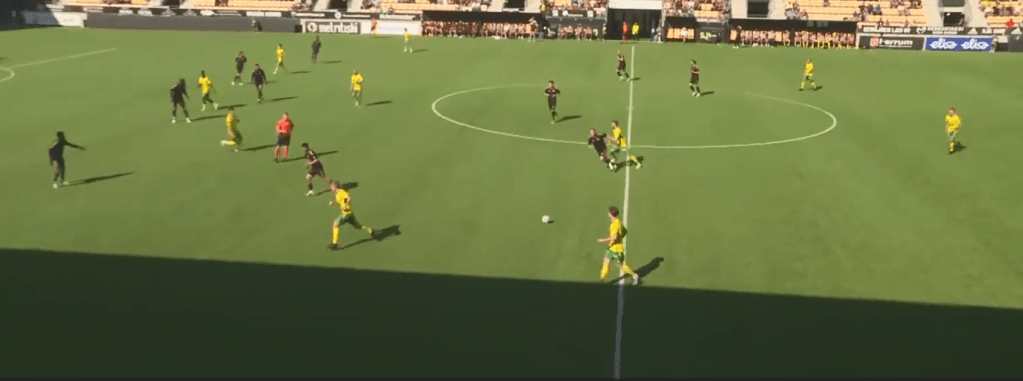
SJK welcomed back Pyry Hannola from a loan spell at Polish team Stal Mielec, and Kasper Paanenen was forced out wide as a right winger. This allowed SJK to have 4 players – Hannloa, Paanenen, Arsalo and Gasc – to potentially play in the middle (with Salim Yussif at right back also a midfielder), the selection making the team stronger in the middle of the field and making the game tighter as opposed to starting the game with natural wingers.
With Ilves pressing high – the front 3 with the high press and wingbacks pressing SJK’s full backs, it was an interesting battle in SJK’s build-up phase and how they would manage to hold onto the ball. Ilves won the ball on the wing in some moments, SJK had moments playing a long ball into the sharper Jeremiah Streng up front.
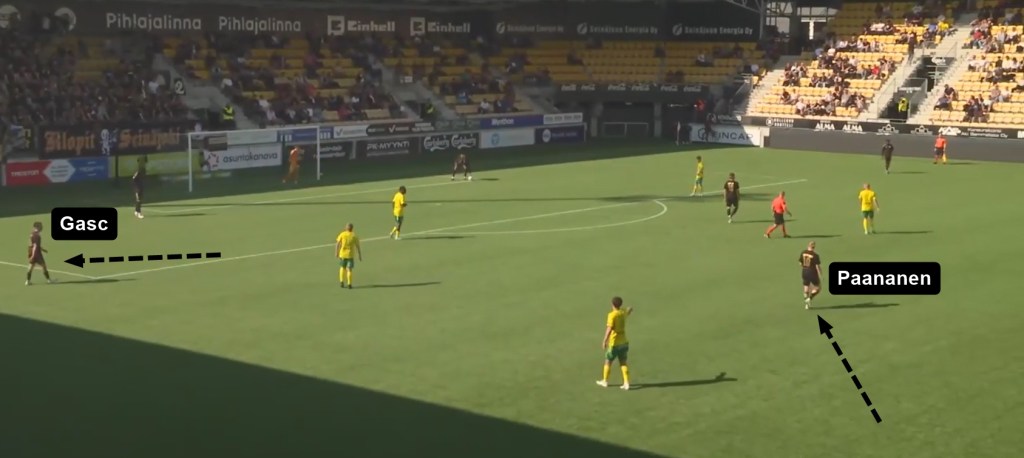
In the following structural battle set up by SJK manager Stevie Grieve (see image below), a rotation occurs on the right whereby midfielder Gasc dropped into the half-space, Yussif at right back (out of picture) pushed up, and Paanenen at right wing dropped into the middle. The ball was played to the left, where the new midfield of Arsalo, Paanenen and Hannola overloaded the Ilves midfield, and Hannola pushed upfield with the ball on the left.
SJK found their first goal in the 14th minute via a well-worked set piece, with Arsalo’s corner finding the bigger-sized Streng at the back post, where he won the initial header for Samuel Chukwudi to head the ball in.
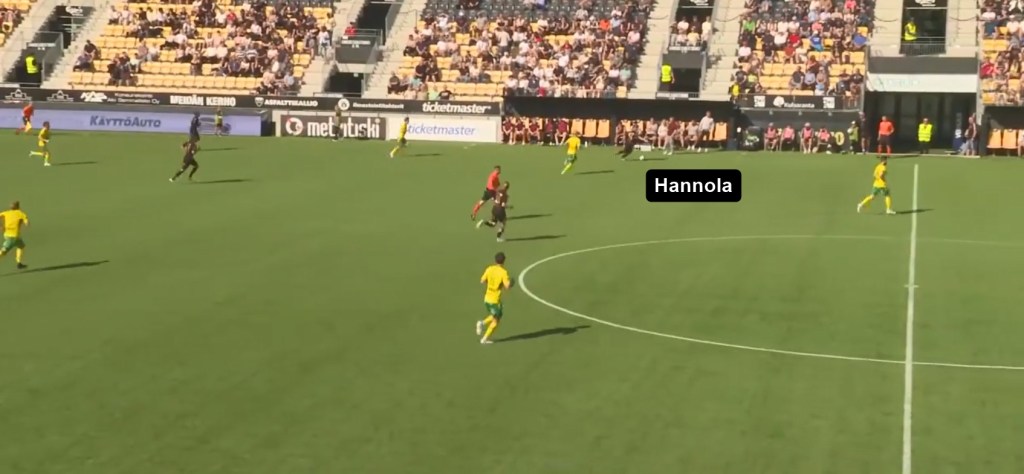
For Ilves, their a significant issue that Ilves manager Joonas Rantanen faced from a tactical perspective was SJK’s direct balls. One direct ball from SJK, for example, GK Roope Paunio‘s ball to STR Streng, or Arsalo’s line-breaking pass (see image below), and 6-7 Ilves players would be taken out of the game.

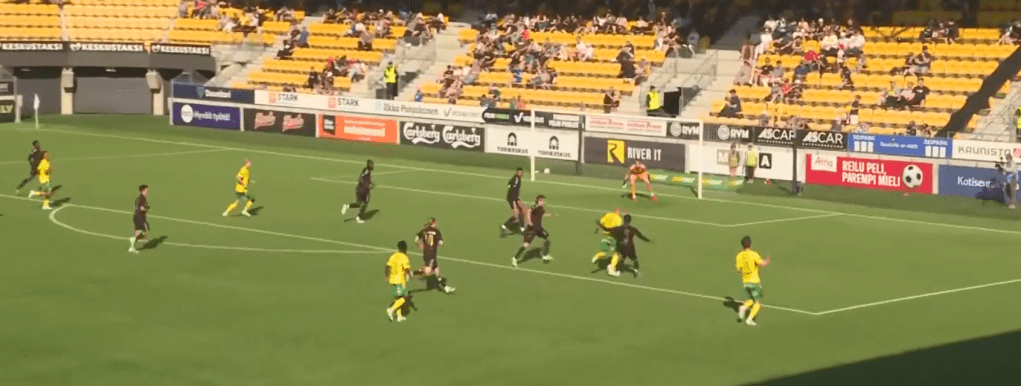
Ilves made multiple attacking changes for the 2nd half. 194 cm Striker Teemu Hytönen came on to provide clever positioning and height, young winger Vincent Ulundu came on as a right-footed left-wing back sticking out wide and cutting in, and the influential Oiva Jukkola was moved to right wing back in place of ex-Bologna youth player Kalle Wallius. Jardell Kanga, on loan from Swedish side Hammarby, came on in the 60th minute as an inverted right winger working the right half-space. These great 2nd half substitutions and the correct 2nd half strategy of continuing to attack the right channel from manager Joonas Rantanen yielded the penalty for the equaliser, though the referee’s decision was incorrect as left-back Babacar Fati got the ball (see image below). The use of VAR in Finland for 2026 will be debated, and the inconsistency with which VAR was trialed in the 2025 season may also come into question, as the loss of three points for SJK could cost them a European place next year.
Overall, we saw a great tactical battle between the two teams. Ilves manager Joonas Rantanen would no doubt be touted to manage a team overseas or for the National Team set-up, while SJK manager Stevie Grieve had settled with his fantastic ideas, which allowed his team to hold onto the ball like the 2009-2011 Barcelona under the great Pep Guardiola.
Here is the player who stood out in this match:
Roope Paunio (SJK), goalkeeper born 2002.
The third-choice keeper for the Finland U21s, Paunio made several excellent stops to keep SJK in the game against good Ilves’ shots on target. The keeper was agile at 190cm, the shot-stopping, reaction and handling were very good, and he was perfect for SJK’s possession style as he could play short and also into striker Jeremiah Streng. Dealing with balls behind the SJK defence and set pieces, for example, the penalty and potentially the corner, would be areas to work on.
His level assessment:
Russia: backup keeper, Denmark: top-mid team
Discover more from Scoutmania
Subscribe to get the latest posts sent to your email.
 Scoutmania