
Haugesund and Moss face off in the decisive 2nd leg of Play-offs final to determine who will play in the 2025 Eliteserien season. For Haugesund, this match represents a fight for survival, while Moss seeks promotion to the top flight after a competitive OBOS-ligaen campaign. Both teams come into this game with distinct tactical approaches and high stakes, promising an intense and strategic battle.

Haugesund, managed by Sancheev Manoharan, lined up in a disciplined 4-3-3 formation. In possession, their midfielders strategically operated in half-spaces to break lines and progress up the pitch. However, as the opposition set up very compact, they frequently used switches of play to exploit the width of the pitch and create opportunities into the final third. Their wingers played a crucial role, receiving the ball in wide areas, stretching the defence and providing dangerous crosses or goal scoring opportunities. Both of Haugesund’s goals came from switches of play, starting from their centre back to wide players, leading to quick attacking transitions in the final third. Defensively, Haugesund set up in a 4-4-2 formation, remaining compact and organised, limiting Moss’ space in the middle and forcing them to play wide.
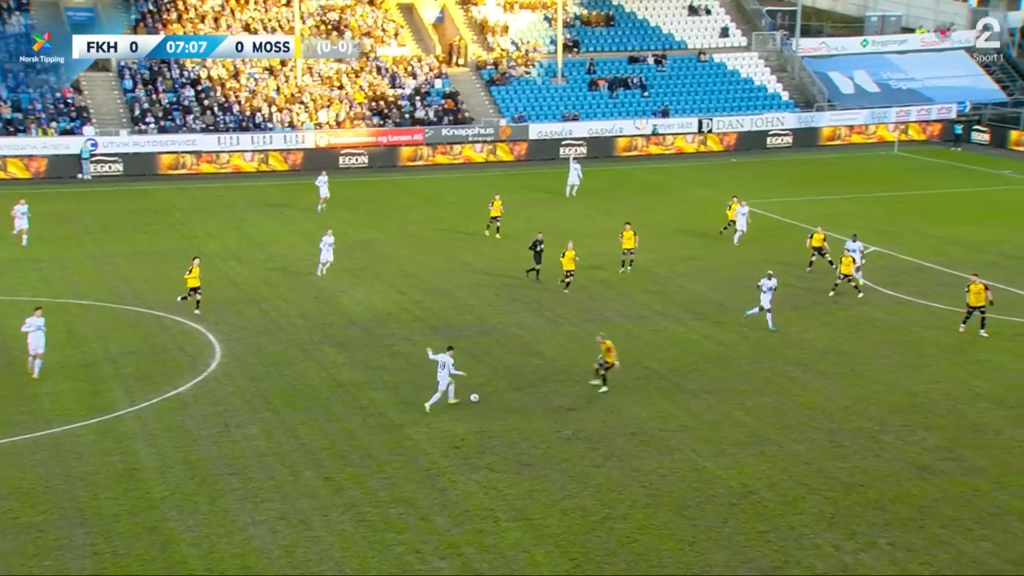
Moss, managed by Thomas Myhre, placed significant emphasis on their defensive shape, transitioning into a compact 5-4-1 formation when out of possession. This structure was crucial in limiting Haugesund’s attacking opportunities, as it forced them out wide and prevented any passes through the defensive lines in the center of the pitch. But Haugesund capitalised on switches of play, exploiting the width of the pitch to score twice within the first 35 minutes of the game.
In possession, Moss transitioned to a 4-3-3 formation, focusing on controlling the midfield and building from the back. They aimed to break through Haugesund’s defence by shifting the ball across the field and attempting to create overloads on the flanks. However, despite their possession control, Moss struggled to create clear-cut chances. Haugesund’s effective build-up play ultimately punished Moss’s compact defensive structure, which had helped secured a 0-0 draw in the first leg.
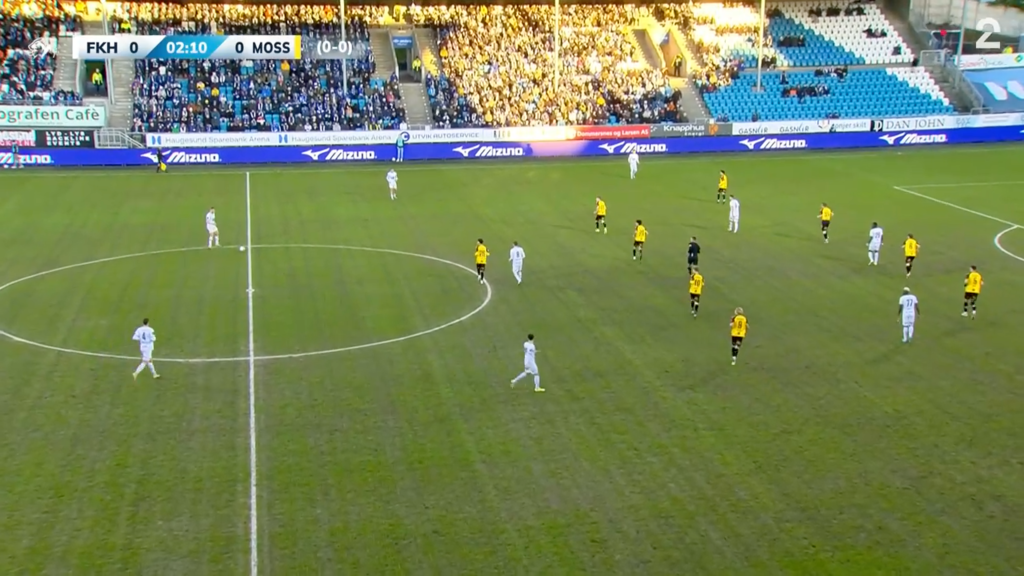
Despite Moss’s well organised defensive structure and focus on possession, they were undone by Haugesund’s clinical use of width and efficient build-up play. Haugesund’s ability to capitalise on key moments helped secure their victory and survival in the Eliteserien.
Best Potential Players?
Sebastian Tounekti (Haugesund), winger, born 2002.
Tounekti was a constant attacking threat throughout the match, creating numerous chances, particularly in 1v1 situations. His dynamic dribbling and ability to take on defenders caused problems for Moss all night. Tounekti was directly involved in both goals, contributing to the first by forcing a deflected own goal after beating two defenders, and assisting the second goal with a well-placed cross. His speed and technical ability make him a key player for Haugesund.
Bo Hegland (Haugesund), attacking midfielder/forward, born 2004.
Hegland was a creative spark for Haugesund, often positioned in advanced areas to receive the ball in the final third. His vision and intelligence were key to unlocking Moss’ offence, and his ability to create goal-scoring opportunities helped Haugesund maintain offensive pressure. Hegland’s quick thinking and movement off the ball made him a constant danger in the attacking phase.
Anders Baertelsen (Haugesund), center-back born 2000.
Baertelsen played a pivotal role in both goals, executing precise switches of play from the back into wide areas. His ability to find the wingers in the final third was crucial in breaking down Moss’ defensive structure, particularly with his long passes that led directly to both goals. Baertelsen’s composure on the ball and accuracy in switching play made him one of the standout performers in this game.
To FOLLOW also:
Oscar Krusnell (Haugesund, born 2000) is an attacking full-back who stood out for his ability to drive the ball into the final third and create goal-scoring opportunities. His pace and offensive runs down the flank make him a key contributor to Haugesund’s attacking play.
Vegard Solheim (Haugesund, born 2004) is a well-balanced full-back, primarily contributing defensively while providing stability to the backline. His strong defensive positioning and tactical awareness make him a reliable figure at the back, helping maintain solidity and organisation for Haugesund.
Alexander Hapness (Haugesund, born 2001) impressed as a number 6, controlling possession and dictating the tempo for Haugesund. His composure and decision-making in midfield allowed his team to maintain control and build attacks effectively.
You can get the full match report for free by liking this post and commenting SEND in the comments section.
If you wish to buy a match report on demand or an individual player development consultation please feel free to reach out.
If you like it SUBSCRIBE to the blog to stay updated with new articles and match reports.
Discover more from Scoutmania
Subscribe to get the latest posts sent to your email.
 Scoutmania